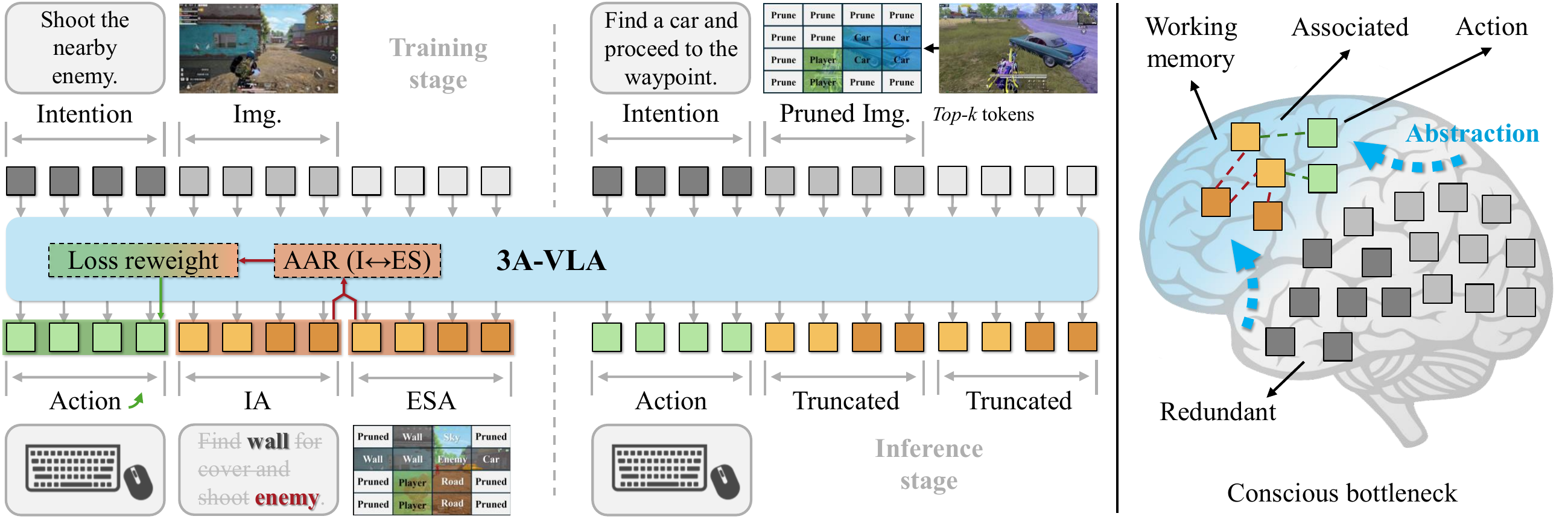
Despite advances in Visual-Language-Action (VLA) models, they remain limited in highly dynamic game settings—such as 3D open worlds and competitive PvP—where agents must efficiently extract sparse, actionable signals from dense visual input while integrating multi-modal cues to track off-screen high-value targets in real time. To tackle this, we introduce 3A-VLA (Abstraction-Aligned Action VLA), a framework that grounds action learning in explicit intention and environment abstractions rather than superficial pattern matching. We introduce dual task-agnostic abstractions: Intention Abstraction (IA), which condenses verbose instructions and reasoning into explicit semantic primitives; Environment Semantics Abstraction (ESA), which structures dense visual streams into a spatial-functional affordance representation to guide grounded action. We further propose an Abstraction Alignment Reweighting (AAR) module that adaptively reweights the action imitation loss. It uses a continuous intention-environment alignment signal to emphasize reliable action supervision when abstractions agree and reduce the influence of ambiguous demonstrations when they diverge, thereby learning a policy that balances fine-grained control and high-level reasoning without manual rules. Extensive experiments show that 3A-VLA establishes new state-of-the-art results in both open-world (Minecraft) and competitive PvP (Game for Peace) settings. It also demonstrates strong zero-shot generalization to high-fidelity games across different domains, including Valorant, CS2, GTA V, Elden Ring, and Mount & Blade.
We establish a taxonomy of six atomic tasks that encapsulate the complete lifecycle of a battle royale match at an intermediate difficulty level (Gold and Silver tiers).
Controlling descent trajectory to land within a minimal radius of a designated waypoint.
Exploring the environment to identify, pick up, and collect essential loot such as weapons and armor.
Detecting adversaries, tracking their movement, and compensating for recoil to deliver lethal damage in encounters.
Identifying knocked-down teammates, navigating to their location, and reviving them to restore their combat status.
Searching for, locating, and boarding available vehicles to secure strategic mobility across the battlefield.
Navigating towards the shrinking safe zone while avoiding obstacles under strict time constraints.